A Tool Asked Me to Do Nothing: A Backyard Field Test
JOURNAL OF THE EXPERIMENT
1080 words · 4.5 min read · Lire en français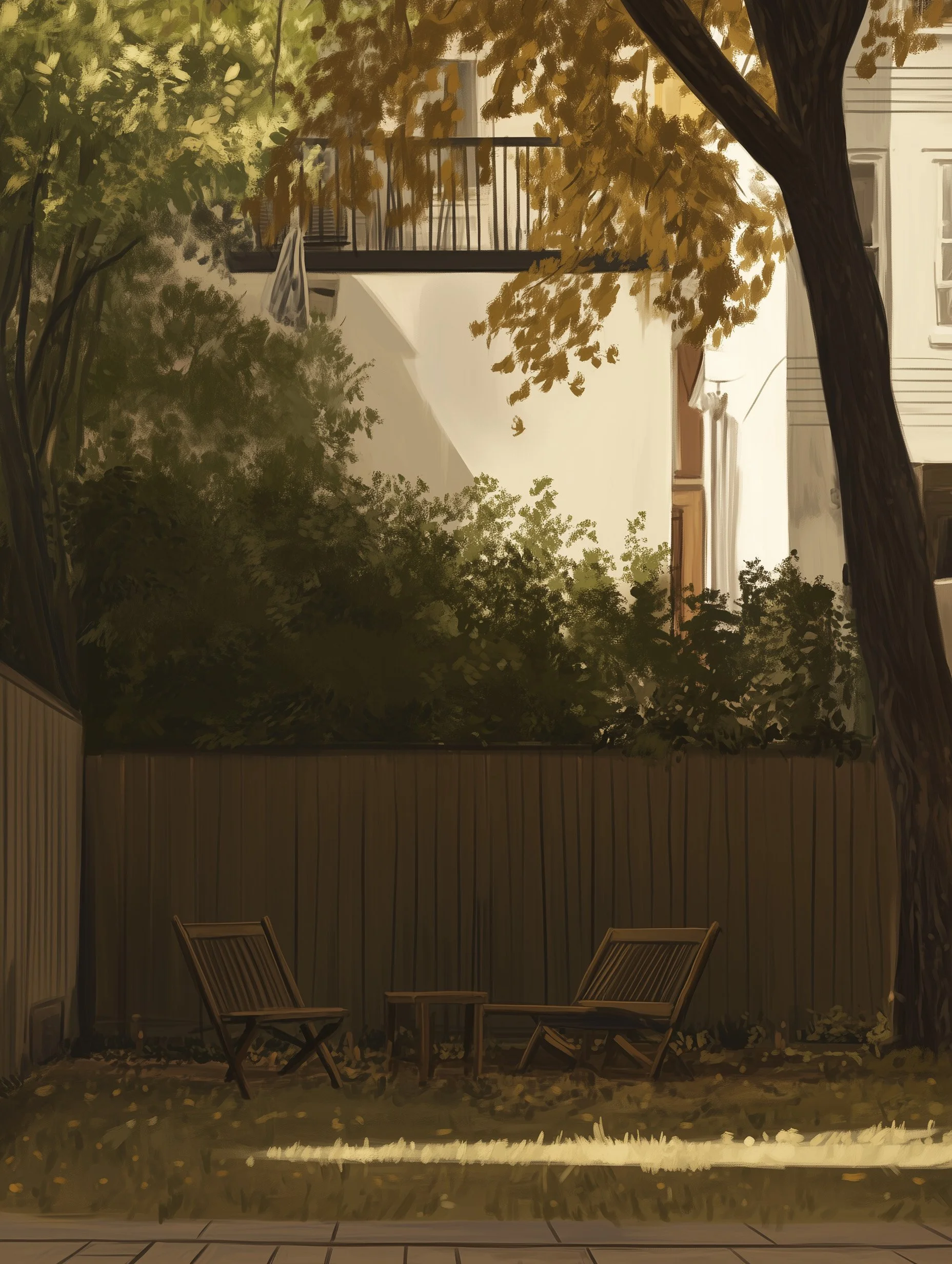
Sometimes the experiment begins where nothing appears to be happening — until attention reveals how much is already moving.
The What Now tool is one of the simplest tools I have created for The Dreamer Project — my ongoing experiment with consciousness in ordinary life, where I test perception, reaction, identity, and our sense of reality. (For those curious about the tool behind this field test, there’s a link to the Journal Annotation below.)
This experiment is part of a three-year process I started on February 11, 2026.
Like many people, I used to imagine that consciousness was one of those questions that required withdrawal, meditation expertise, psychedelics, or special equipment. A monastery. A philosopher. A neuroscience lab.
That instinct was not wrong. Those places and forms of knowledge still matter. But my project begins somewhere else each day: in the middle of life already in progress.
A drive.
A walk.
A conversation.
A room.
A backyard.
The What Now tool helps by selecting one field test at random from a list I have already written.
Sometimes it asks me to drive in silence. Sometimes to walk without my phone. Sometimes to sit in a café and notice what my mind makes of the room. Sometimes to walk on a busy street and track irritation, attraction, comparison, belonging, or whatever story starts forming before I notice it.
And today, it asked me to stay home and look at the backyard.
That was the assignment:
What Now: “Stay home and look at the backyard for twenty minutes. Notice stillness, weather, animals, light, and small movement. Observe boredom, quiet, and where attention goes.”
This time, What Now did not ask me to use a specific practice from the catalogue. It asked me to observe. So my laboratory for the day was:
two chairs,
a tree,
some insects,
the neighbor’s building — very advanced!
and me, immediately trying to negotiate the instruction.
I set the timer for eighteen minutes because I had already been there for what I estimated was about two minutes. So already, before anything profound had happened, I had found a very small way to negotiate with stillness.
That is probably the first thing I noticed.
Not silence.
Resistance to silence.
I realized almost immediately that I had not intentionally done nothing outside for twenty minutes in a very long time. Usually, if I'm outside, I'm reading something, fixing something, watering something, listening to something, checking something, or thinking about the next thing.
The backyard was not peaceful at first. It was busy.
A bee became an irritation.
A spotted lanternfly, a judgment.
An ant on my glasses, a small doorway into the spring story: ant killer, control.
An unusually low commercial airplane crossing above the house, a small anxiety.
Nothing dramatic.
Just the ordinary mind doing what it does: turning contact into management.
This is partly why I built the What Now tool. Not to make life more efficient. Not to optimize my day. Not to turn attention into another productivity system. But to give me a constraint I did not fully choose.
That matters because, in an experiment on consciousness, the choice of conditions is never neutral. I would probably choose the walk when I feel like walking. The silence when I already feel quiet. The practice when I am ready to see myself as someone who practices.
Randomness interrupts that a little.
It gives me the field of play.
The tool provides the constraint.
The world, the material.
The mind, what passes through.
What passed through the mind was not especially favorable. I was sincerely engaged and available, but also a little restless and distracted.
Then, after a while, other things appeared.
A black bird with red visible inside its wings.
Two seagulls.
A young bird recently out of the nest.
A dragonfly.
The sound of insects.
The quiet strangeness of there being a backyard at all.
That last part stayed with me.
Sitting there, I remembered the old apartment with no direct access to the outdoors. I remembered holding onto that apartment for a long time because of its proximity to Manhattan, not knowing what it would feel like to live in a house, to step outside without needing to go anywhere.
The backyard became more than a backyard.
It became a comparison between one life and another. It became gratitude, but not clean gratitude. There was also the feeling of having missed something before I knew I was missing it.
It was as if the mind could not let the present moment stay simple. It kept separating the backyard from itself — turning it into memory, comparison, gratitude, regret.
The task did not silence the mind. It did not turn the backyard into a revelation. It did not make me peaceful in any final way.
But it made the mind visible.
It showed me how quickly attention reaches for irritation, control, memory, comparison, and longing. It also showed me that when attention softens, even a little, the world becomes more available.
Not transformed.
Available.
The red inside a bird’s wings.
A small patch of light.
This very simple thing: trying to do nothing for twenty minutes, and realizing that even this is difficult.
This is also what motivates me to design tools that can help me practice calm, attention, or peace when the occasion is given — and when, even then, the mind still resists.
It is what I am beginning to understand about a tool like What Now, and the other tools I keep building around the experiment — Daily Allocator and Practice Match, for example.
Some assign practices. Others assign constraints.
Sometimes the task is simply to observe before explaining. Other times, it is to orient perception before entering the situation.
They are not the experiment itself. Like scaffolds, they help me ask the question more regularly, and in places where I might otherwise forget to ask it:
If ordinary life is my laboratory for consciousness, what stance can I learn to take — and what happens to experience when I orient it that way?
I am working on the design of a laboratory for consciousness. Not in a grand way. Not as a belief. Not as a slogan. But in the middle of a day already in progress.
A drive.
A walk.
A room.
A street corner.
A backyard.
Of course, my small apps do not answer the question — what is the nature of our reality?
They simply give me the next place to ask it.
Further reading / internal links.
Experiment Log — for ongoing field notes from the three-year consciousness experiment.
How The Dreamer Project Works — for the method behind tools, constraints, practice conditions, and logs.
The What Now Tool — for the Journal Annotation explaining the random field-test selector behind this piece.
Consciousness-First Principles — for the perceptual shifts that guide the experiment.
We The Dreamer Core Practices — for the practice library referenced in the field-test system.