The What Now Tool: Randomness, Constraints, and Ordinary Life as a Field Test
JOURNAL ANNOTATIONS730 words · 3 min read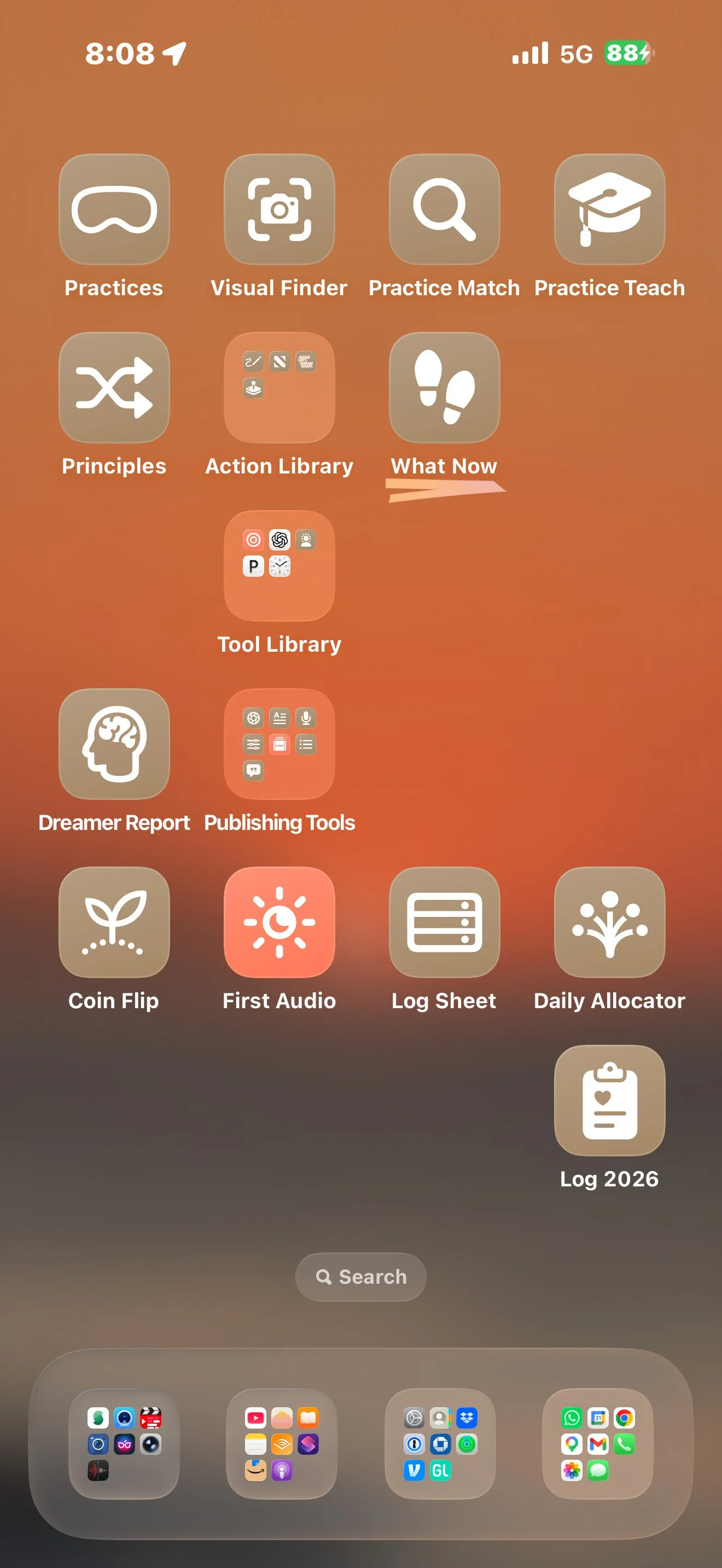
These tools do not replace practice. They create conditions: a random assignment, a morning calibration, a log, a question repeated until ordinary life starts answering back.
The What Now tool is one of the simplest tools I have created for The Dreamer Project.
It selects a field test at random from a list I have already written. Sometimes the assignment is only the field test itself. Other times, the tool adds a condition: observe only, use a practice, compare before and after, flip a coin, apply the practice proactively, or wait and apply it reactively once a pattern appears.
But “field test” is the important part.
The tool is not only asking me to do something. It is placing ordinary life inside a constraint, so that attention, perception, reactivity, identity, and relationship can be observed with a little more discipline than usual.
Some assignments are observational only. They do not ask me to apply a practice yet; they ask me to notice what appears in attention, perception, reactivity, identity, or relationship while I drive, walk, sit, listen, or look.
Other assignments include a practice condition. I might be asked to apply a practice from the We The Dreamer Practice Library, compare a situation with and without practice, or wait until irritation, attraction, anxiety, judgment, or separation has already appeared before applying a practice.
That difference matters.
If I only use the tool when I already know what kind of test I want, the experiment becomes too friendly to my mood. That does not mean every day needs a field test. A day without a morning calibration, a practice, or an assigned condition still has value; it can be logged too. But when I do choose to enter the experiment, randomness introduces a condition I did not fully design around my comfort.
Randomness interrupts that.
It does not make the experiment objective in a scientific sense. I am still the person observing and recording. But it does introduce pressure. It gives the day a condition I did not fully choose.
Sometimes the condition is simply: observe.
Other times, it might be:
use one practice;
compare without practice and then with practice;
apply the practice before entering the situation;
wait until the pattern appears, then apply the practice;
or let chance decide.
This is where the tool becomes useful for The Dreamer Project.
The project is not testing everything and anything. It is testing a specific possibility: what changes if ordinary life is entered, again and again, under the hypothesis that consciousness may be fundamental — that reality may be something closer to one mind dreaming the world together than separate minds moving through an independent outside.
The What Now tool gives that question field conditions.
It is not only asking whether a consciousness-first frame can feel meaningful in quiet moments. It is asking what happens when that frame is tested in ordinary life: under stimulation, boredom, judgment, beauty, resistance, memory, pressure, and distraction.
A drive can become a test of stimulation and attention.
A sidewalk can become a test of projection.
A café can become a test of social imagination.
A backyard can become a test of stillness and restlessness.
A political podcast can become a test of side-taking.
An ugly street corner can become a test of disgust, separation, and the stories that follow.
The point is not to prove that the hypothesis is true.
The point is to describe the event as it appeared in experience.
What changed in attention?
What changed in perception?
What changed in reactivity, identity, or relationship?
What resisted change?
What surprised me?
What remained unchanged?
Sometimes I can log a clear perceptual shift. Sometimes I can log the use of a consciousness-first principle, a We The Dreamer practice, or one of the core, perceptual, or relational practices. Sometimes there is no practice at all, only observation — which is also part of the test.
And sometimes nothing much happens.
That matters too.
The log has to preserve absences, ambiguities, and null results. Otherwise the project becomes self-confirming. If I only record the beautiful moments, the experiment quietly turns into a story about itself.
So the What Now tool is not there to organize my every move.
It is not there to automate awakening into a mind-first reality.
It is not there to make ordinary life more poetic.
If anything, it does something less glamorous: it makes ordinary conditions usable — traffic, waiting rooms, long lines, kids’ sports games, awkward pauses, boring errands, overstimulating streets.
It is a small system for assigning conditions.
The tool provides the constraint.
The world provides the material.
Time provides the duration.
The mind provides what passes through.
Then I try to record what actually happened before explaining it too quickly.
That may be the most important discipline of the tool: to stay with observation before interpretation. Not “why did this happen?” Not “what does this prove?” Not “what beautiful lesson can I extract?”
But first:
What appeared?
What shifted?
What did not shift?
What did the assigned condition change, if anything?
What stayed exactly the same?
The What Now tool does not answer the central question of The Dreamer Project.
It simply gives me the next place to test the hypothesis — under a condition I did not entirely choose.