The Hypothetical Population
JOURNAL ANNOTATIONS
550 words · 2.25 min read
This Journal Annotation was created for the Why The Dreamer Project page. It extends the thought experiment into a collective register, asking: what if humanity itself became the laboratory for testing awareness-first identity?
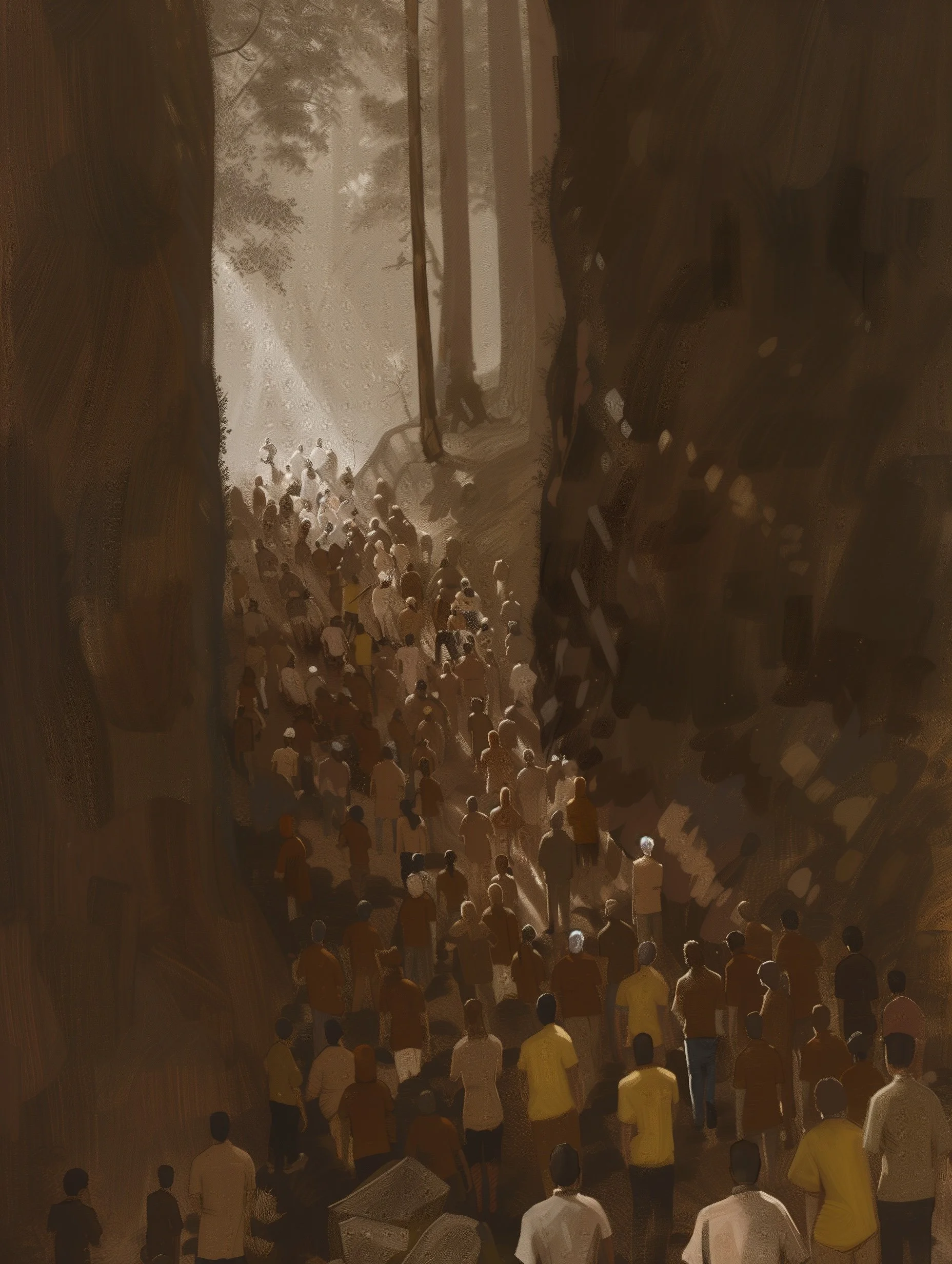
To imagine a new population is not to predict the future, but to test whether presence, shared at scale, can bend the dream of the world toward clarity.
We model galaxies with math. Could we model humanity with presence? Cosmologists ask impossible questions and treat them seriously: what if the universe has no edge, or splits into multiverses? They run simulations even when the answers sound like science fiction. The Dreamer Project borrows this posture: what if we asked, just as seriously, what humanity might look like if identity itself were tested differently?
Imagine a population shift. Suppose millions of people, in chosen hours of their lives, stopped running on stress and defensiveness. Suppose they toggled into Dreamer mode, practicing qualities like presence, clarity, generosity, and oneness as test conditions. Not to become saints, but to see what identity feels like when it is no longer bound by separation. To choose We The Dreamer, as the page puts it, is “to face urgency differently — not with panic or denial, but with a willingness to reimagine identity as shared mind. And perhaps in that shift, something in humanity also remembers.”
What would ripple out if even a fraction of such a population existed? Conflict would look different when fewer people play the game of retaliation. Innovation might accelerate when creativity is freed from the chokehold of fear. Education could tilt if curiosity were cultivated alongside literacy. Economies themselves might bend if cooperation, rather than scarcity, became the default stance.
None of this population exists yet. But the hypothesis matters. It exposes the gap between the identities we inherit — roles, tribes, algorithms — and the identity we might uncover if awareness itself became the reference point. The Dreamer Project positions itself not as a movement but as a field test: can consciousness-first qualities be trained, observed, and shared at scale the way Montessori once tested education, or mindfulness was tested in medicine?
To push the speculation further: what happens when such a population meets resistance? History shows that new ways of seeing are never welcomed evenly. Imagine a near future where physicalists defend their creed of material primacy while idealists argue that consciousness is fundamental. Interviews and debates from the early twenty-first century already sketched the outlines of such a divide. In this scenario, the hypothetical Dreamer-trained population becomes not a utopia, but a contested presence: a living question that neither side can fully dismiss.
This is why the exercise matters. It reminds us that identity can be treated as a variable. Personal identity as universal identity; separation as oneness tested in the hours of daily life. The outcome is unknown. That is the point. We cannot yet model what happens when presence replaces panic at scale. But we can ask. And perhaps in asking, something in humanity also remembers.
Further Reading.
We The Dreamer — Philosophical Vision
Why The Dreamer Project?
Consciousness-First Principles
Bibliothèque: David Chalmers, Reality+ — on simulation and the future of identity.
Donald Hoffman, The Case Against Reality — perception as interface, not truth.
Annaka Harris, Conscious — consciousness as irreducible mystery.
Montessori, The Discovery of the Child — an early model of testing education as identity formation.
Meta Note
This page is a living document. Last updated: New post.
Connection: Extends the Why The Dreamer Project page by testing the idea of identity at a population scale.
