THE DREAMER PROJECT

First Dream Programs

Try the First Dream experiment. Eyes-open drills that drop heat, steady choices, and repair fast—an antidote to autopilot.

Last updated: March 18, 2026

Practice Library · Videos · Walkshops · Studio Sessions · Salon · Art & Design

In a world wired for outrage,

First Dream is quiet refusal.

Join the interest list.

INVITATION

Training for perceptual fitness.

Short drills. Real scenes. Clean mind-first moves.

Run the experiment*. Choose to act on a living theory — see We The Dreamer — and try it in motion: in hard rooms, stand as a dreamer and hold everyone in it, including you, as if you belong to the same field. Widen the mind-scape, see life from a mind-first lens, and keep what lowers heat, improves repair, and expands your usable range under stress.

Hands-on, eyes-open training in plain language. Short visualizations, quick reps, and drills you can run anywhere.

Ways to Practice.

  • This is a drawing by Martin Lenclos representing the It's Dreamnow, Not Spacetime practice

    Web — Practice Library

    A searchable set of field tests and prompts you can run solo — quick, secular reps designed to shift perception in ordinary life.

  • Martin Lenclos speaking to the camera for his video series

    Video — Series on Social

    Short visualizations and plain-language reps to loosen rigid identity, relate more cleanly, and practice the stance in real time.

  • The First Dream walkshop takes place at street corners and cafés. A teacher is surrounded by students.

    Walkshop — Outdoors

    Guided city walks that turn sidewalks into studios to train attention in live scenes and end with rapid moves you can reuse.

  • A group is meeting for a mind training session.

    Studio — Indoor Practice

    Small-group practice with timed reps, cue cards, and debriefs to refine stance, run drills, and learn simple protocols.

  • Group of people gather in a small space to discuss philosophy

    Salon — Philosophy Nights

    We explore the consciousness-first hypothesis — and what changes when you test it. Conversations, books, and tasting.

Person in a neutral-toned suit stands calmly with hands in pockets as papers swirl through the air and a low cloud of fog gathers behind, evoking steadiness amid mental noise.

WHAT FIRST DREAM TRAINS

First Dream shifts you from a world
happening to me

to a scene
arising in awareness.

You work from the one-field view: each moment is met as if it appears inside a single shared field, which lowers heat and often clarifies the next step.

Instead of a small self wrestling a hostile outside, you begin to move as a dreamer: the clear observer inside a live scene—roles, traits, décor included—free to act with precision.

The world doesn’t vanish; your posture changes.

People (including you) are met as expressions within a shared dream of separation. From here you can wake a notch, stand as a dreamer in the room, and move more cleanly.

“Mind-first practice isn’t doctrine; it’s how I meet the whole scene at once and move cleanly. Try it in motion — let your day be the lab.”

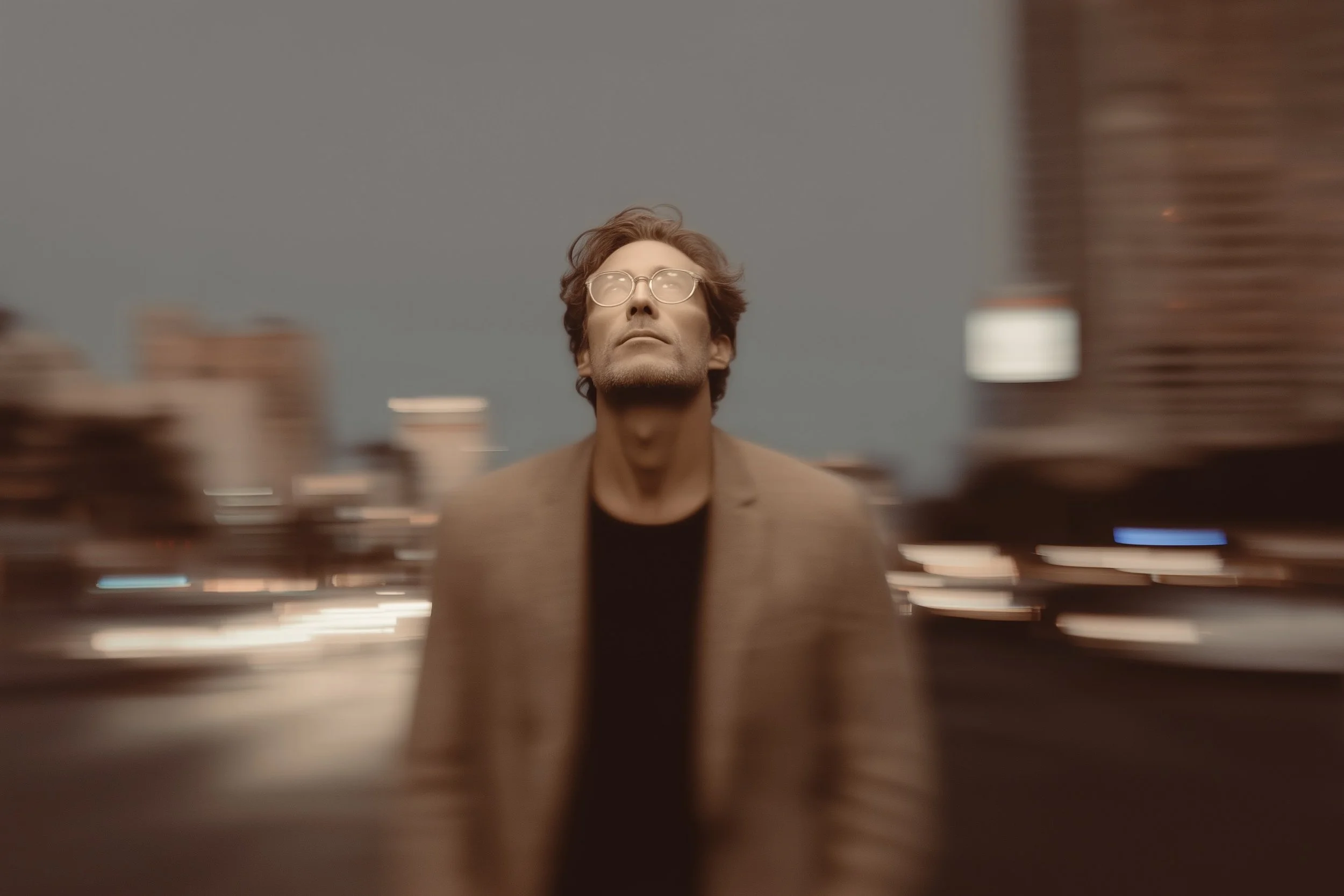
Digital illustration depicting a man with glasses, wearing a brown blazer, looking upward with eyes closed, standing in front of a city skyline at dusk with blurred lights.

Calm Without Retreat

Because the day really does bite back. Identities fracture, feeds reward spikes, and institutions feel captured. Trying to “make a dent” can feel impossible. In that climate, choosing the dreamer stance is radical because it refuses the default script: it drops heat without dropping responsibility.

Becoming a dreamer isn’t fantasy or escape. It’s the discipline of how you perceive while life stays messy: stand as a dreamer, act as if the moment arises in one shared field, wake a notch inside the scene, widen your view, soften attention, take the next clean step.

Duties stay intact—apologize, set boundaries, pay bills, see doctors. What dreamer training does is narrow and concrete: it softens the reflex to make enemies, the guilt that freezes action, and the habit of treating the world as the cause of your inner state. That’s why it’s radical: it’s a refusal to feed the spike economy and a commitment to act from steadiness.

ART & DESIGN PROGRAMS

Mind-First Art & Design

Create from the Dreamer stance. Use the consciousness-first hypothesis as a lens and Design for Nothing.

  • An art furniture piece created by Martin Lenclos in a gallery in Dumbo, Brooklyn, 2022

    Exhibition — Art Gallery

    By day, a gallery for art that tilts perception. Each piece has a “use card” (what it tests / how to hold it / what to notice). In the evening the room flips to salons, classes, and openings.

  • Man participating in a video call with woman on computer in a modern, sunny indoor setting.

    Workshop — Mind-First AI

    Collaborative sessions where AI is used as a stance mirror, not an answer machine. We iterate on a live moment “as if arising in one mind,” then choose one cleaner action together.

    Visit Creative Catalysts →

  • A pottery class

    Class — Art Session

    A studio class where we make art and prototype small Self-Questioning Devices that interrupt habit. We work with simple materials, tight constraints, and a test-to-fail loop.

  • An outdoor photography class.

    Photo Walk — Outdoor Class

    Perception-shift + photography walks that turn the city into a field lab. The route is simple; the stance is the work. Micro-visual training to soften attention and widen peripheral.

This is only one doorway.

Explore the Practice Library — a collection of creative field tests with hand-sketched cues to spark new shifts in perception and test the consciousness-first hypothesis in daily life.

The Dreamer Report — YouTube

Every perception shift is a note in the record.

Join Martin Lenclos in The Dreamer Report — experimenting, noticing what shifts, and sharing what he finds.

Illustration for app of We, the Dreamer — A visual of hallway with mirrors and narratives

COMING SOON

A companion app for practice, insight, and collective research.

Designed as a future-phase project, the WTD app will offer a closed, immersive environment where readers can explore full-length practices, conversations, and follow-up exercises from the book. In addition to daily mind-training tools and consciousness-first challenges, the app will track experiential shifts and support peer-based awakening—contributing valuable insights to our collective research on perception and identity.

Launching in a future development phase (2026+), the app is part of the long-term architecture of We The Dreamer: a space where awakening becomes both personal and participatory.

*ABOUT THIS EXPERIMENT

The Dreamer Project (including First Dream, We The Dreamer, and the Practice Library) explores a consciousness-first worldview through creative and phenomenological means. This work is experimental by design. It makes no claims of scientific proof or therapeutic efficacy. No current evidence confirms or denies that consciousness is fundamental, or that these practices produce measurable benefits.

Participation is voluntary and self-directed; challenging reflections are possible—that risk is part of the inquiry. If you’re navigating mental-health concerns, please seek guidance from a qualified professional. This is offered for educational and philosophical exploration—a field test in perception, not a path of belief.

META NOTES

This page is a living document. Last updated: Newly created on November 3, 2025