The Hypothetical Population
JOURNAL ANNOTATIONS
1146 words · 4.5 min read · Also in French
This Journal Annotation was created for the Why The Dreamer Project page. It extends the thought experiment into a collective register, asking what might become visible if identity itself were treated as a variable in ordinary life.
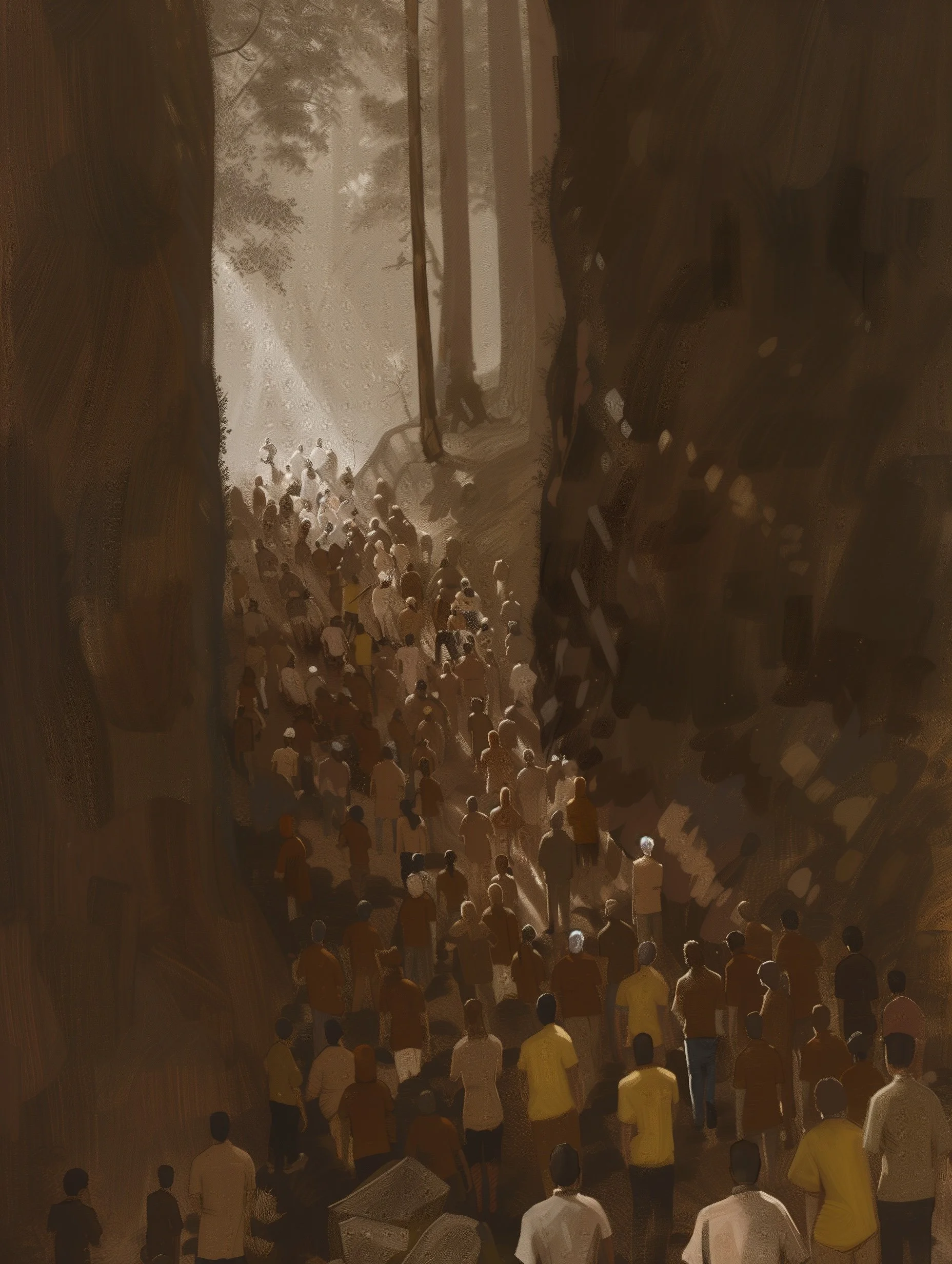
A population is never only a number. It is a way of seeing, reacting, fearing, hoping, and deciding what “we” means.
We use mathematics to model galaxies. Could we also model the identity-conditions from which human behavior emerges?
Cosmologists ask questions that can sound impossible and still treat them with rigor: what if the universe has no edge, or if our universe is one of many? They build models not because the model is the universe, but because a model can make a question more precise.
This annotation borrows something from that posture. It asks: what would happen if identity were not treated only as a fixed possession, but also as a condition that can be temporarily tested?
Imagine, then, a hypothetical population — a thought experiment in collective form.
Not a utopia. Not a movement. Not a prediction.
Only a way of asking the question at scale.
Suppose many people, in chosen hours of their lives, practiced entering ordinary situations from different assumptions about self and world — not as beliefs, but as test conditions. What if separation were not simply a fact, but also a way experience organizes itself around a “me” and an “other”? What if identity were not exhausted by the personal self, but could be tested from a wider field of awareness? What if feelings were not verdicts about reality, but weather made meaningful by mind?
Instead of assuming that conflict, fear, value, and relationship arrive fully formed from the outside, they would observe what changes when these are approached as structures appearing within experience.
Not to become better people on command. Not to prove a metaphysical claim. But to observe what changes when identity is less tightly organized around separation.
What might shift if even a small fraction of such a population existed?
The world would not become less difficult by assumption. Harm would still happen. People would still suffer. Conflict would still divide. But the model of separation shaping perception might become more visible — like a machinery whose parameters begin to reveal themselves.
Blame might still appear, but perhaps with less authority. Retaliation might still be available, but not always as the first move. Fear might still speak loudly, but it might no longer obscure our whole field of vision. Attention might begin to notice how quickly it turns difference into threat, pain into certainty, and the other person into a fixed role.
The argument would not be to produce an ideal population. The point would be to test whether reaction begins differently when identity is not organized so quickly around separation.
At scale, even a small shift before reactivity becomes identity would be worth modeling — not as proof of oneness, but as data about what becomes visible when separation is tested rather than treated as incontestable.
No population defined in this way exists yet in any measurable form. That is precisely why the model remains hypothetical.
The experiment is still young. I began this three-year process in February 2026, so it would be too early to claim measurable conclusions. At most, the early data collected seems to be revealing recurring patterns worth watching: moments when perception loosens, when reactivity is noticed before it becomes identity, and when separation becomes visible as a perceptual condition rather than remaining the unquestioned ground of experience.
Such a population would not be recognized by labels — spiritual, rational, skeptical, awakened, or simply convinced of holding the more reasonable view. It would be recognized, if anywhere, in what can be observed under pressure: whether perception loosens, whether reactivity is noticed before it becomes identity, whether separation can become visible as a condition rather than remain the unquestioned ground.
The value of this thought experiment is not that it predicts the future. Its value is that it gives the central question of The Dreamer Project a collective form.
If the hypothesis that consciousness is fundamental to reality were even partly true, then much of what we take for granted about self, world, others, separation, and our deepest differences would have to be reopened. Not rejected all at once. Not replaced with doctrine. Reopened.
That is why a population capable of keeping the hypothesis open matters. A population able to say: “what if?”, “why not?”, and perhaps most importantly: “we do not know yet.”
Not because it would prove that consciousness is fundamental. It would not. But because it would ask what becomes visible when many people repeatedly test the same possibility: that the feeling of being an individual, separate, materially bounded self may not be a definitive fact, but a structure less final than it appears, arising within lived experience.
The Dreamer Project positions itself not as a movement, but as a field test. Can consciousness-first orientations — shifts in perception, identity, reactivity, and relation — be trained, observed, recorded, and shared without becoming doctrine? Can a first-person shift remain accountable to ordinary life, repeated practice, and null results? Can identity be treated, carefully, as an experimental variable?
That last question may be the most important one here.
If consciousness is fundamental, then perception is not a secondary detail. It may be the first creative act — perhaps the first place where freedom can still enter.
So the test is not simply to imagine an “awakened” population — calmer, kinder, more just, or more cooperative. That would still be too idealized a vision. The test is rather to observe whether the point of view from which a situation is perceived can be reoriented before it becomes fixed as separation: “me against you,” “the world against me,” or “that’s just life.”
Concretely, this means testing two slight shifts in perception.
First: what changes when identity is tested as a relational field — less “me here, the world over there,” and more a situation appearing in the moment, through the relation between consciousness, perception, and reality?
Then: what changes when identity is tested through The Dreamer Stance, one of the core We The Dreamer practices — a temporary way of entering a situation as if one mind were appearing as the whole scene, less as the defended individual, and more as the one noticing how perception is already shaping the lived scene?
The freedom being tested here is not total control over perception, but the possibility of noticing it early enough to orient it differently — with just enough distance not to mistake it for the whole situation.
My experimentation with The Dreamer Project is to enter these positions carefully, observe what each one makes possible, and record what remains unchanged. No final truth has to be accepted. If the experiment asks anything, it is to stay honest enough not to turn a hypothesis too quickly into an identity.
But to push the speculation about this hypothetical population further: what happens when such a population meets resistance? New ways of seeing are rarely received evenly. An experiment about the nature of identity and reality would not float above disagreement. It would enter debates already underway: materialist and idealist accounts of mind, social theories of identity, religious frameworks, secular skepticism, and the very ordinary pressures of daily responsibility. It is not a place for naïveté.
In the vision I am sharing with you, this “hypothetical population” is not the result of an already established theory. It is more like a living question — one that neither metaphysical enthusiasm nor reductive dismissal should close too quickly. The still-open debate around the Hard Problem of consciousness at least reminds us of this: we still do not know exactly how to situate conscious experience within our description of reality.
This is why the thought experiment has to return to practice. The important question is not whether such a population sounds inspiring, but whether repeated tests could produce usable traces: moments when perception loosened, reactivity changed, identity shifted, relation softened, or nothing meaningful happened at all.
Without that data, the hypothetical population remains only a concept. With it, the speculation becomes more precise. We could begin to ask which identity-conditions actually change experience, which collapse under pressure, and which leave the ordinary — including behavior — unchanged.
We cannot yet model what happens when presence replaces panic at scale. We cannot assume that the result of a large-scale study of the hypothesis that consciousness is primary would be simple, peaceful, or even stable. But we can learn to ask the question with more discipline.
Some might call for a renewal of reason, science, and secular responsibility — a “second Enlightenment.” This thought experiment asks a neighboring question: would such a renewal also require a transformation in the identity-condition from which reason is used?
Or again: if identity, like attention or behavior, could be tested under different conditions, what would that require in terms of practices, interfaces, and forms of organization?
For me, and for The Dreamer Project, this becomes another way of asking: what would an Enlightenment of perception require?
Further Reading.
We The Dreamer — Philosophical Vision
Why The Dreamer Project?
Consciousness-First Principles
Bibliothèque: David Chalmers, Reality+ — on simulation and the future of identity.
Donald Hoffman, The Case Against Reality — perception as interface, not truth.
Annaka Harris, Conscious — consciousness as irreducible mystery.
Montessori, The Discovery of the Child — an early model of testing education as identity formation.
META NOTE
This page is a living document. Last update: Revised the original annotation for greater restraint and methodological clarity. The piece now frames the hypothetical population less as a future ideal and more as a thought experiment in collective form. It clarifies that such a population would not be defined by spiritual, rational, skeptical, awakened, or reasonable labels, but by what could be observed under pressure: whether perception loosens, whether reactivity is noticed before it becomes identity, and whether separation can be tested rather than simply believed.
The update also brings the article more explicitly back to the consciousness-first hypothesis, the role of perception as a possible first creative act, and the need for repeated practice records — including ambiguity, collapse, and null results — before any collective claim could be made.