Beginning a PhD in Philosophy: Perception, Consciousness, and Ordinary Life
ESSAYS
550 words · 2.5 min read · Lire en français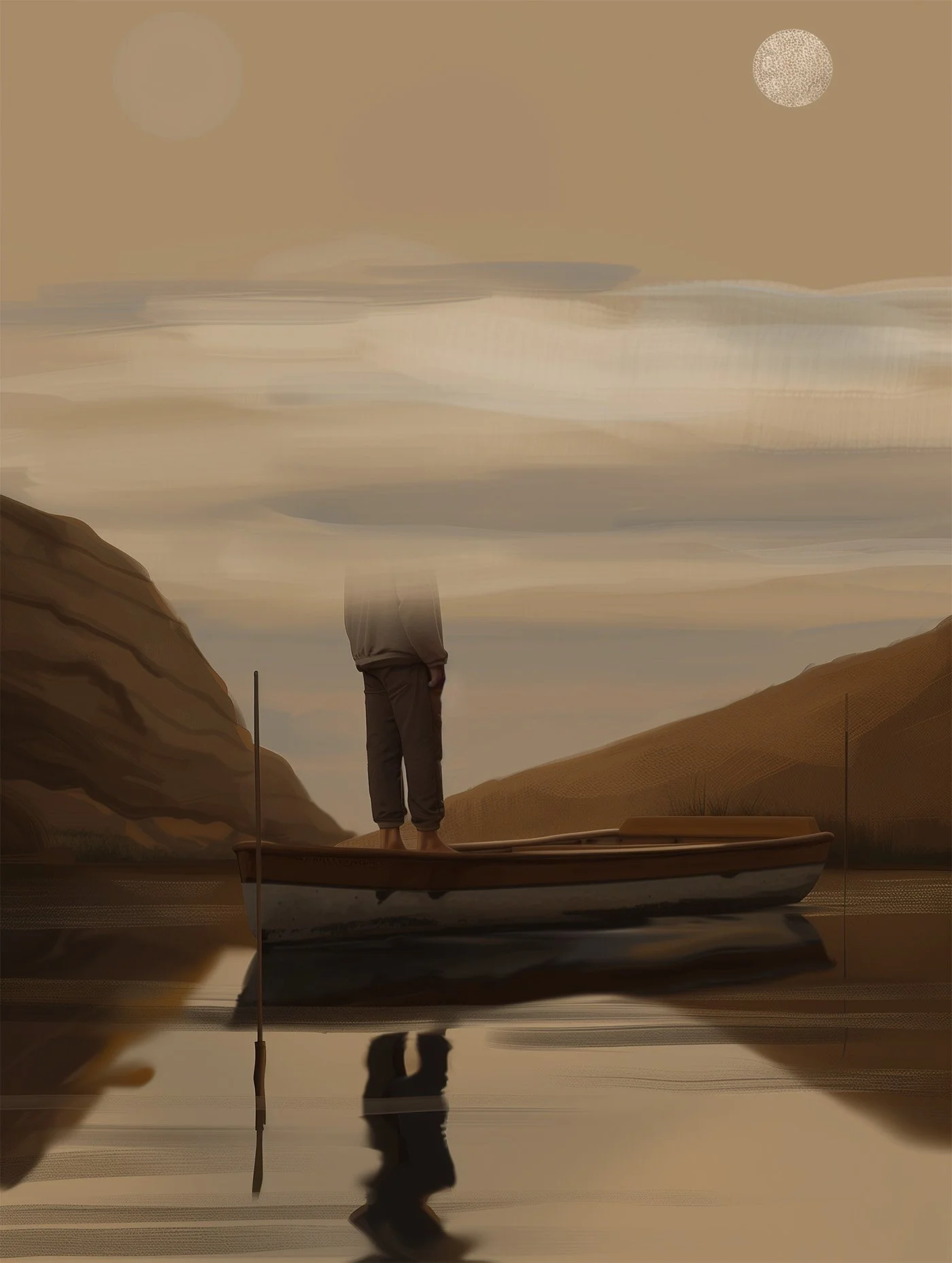
A change on the surface, a continuity in the mirrored image, a new stage in an older question.
For those who do not already know, I will begin a PhD in Philosophy, Cosmology, and Consciousness at the California Institute of Integral Studies this fall.
The project grows out of a question that has followed my work for years:
How does our first reading of a situation shape what we notice, decide, and do next?
By first reading, I mean the interpretation that can form before we have fully examined a situation. We may already have decided what it means, who we are within it, and how we should respond. That first reading can shape our attention, decisions, reactions, relationships, and even the kinds of ideas we are able to produce.
Behind this practical inquiry is an older philosophical question about the relationship between mind and reality. Rather than leaving that question at the level of theory, I want to investigate it through lived experience, with ordinary life as the primary site of experiment and design as part of the method.
For me, design does not mean only producing useful or desirable objects or interfaces. It can also mean framing a question, constructing a situation, testing a possibility, and creating a bounded practice whose effects can be observed.
I have already begun developing participatory perception studies, objects, and everyday exercises that temporarily change how a situation is framed. The Dreamer Project is one part of this work: a series of first-person experiments and simple tools for observing what happens when a person deliberately shifts perspective.
I am not trying to use personal experience as proof of a metaphysical claim. I want to ask more modest questions.
Does a different first reading alter a decision?
Can it reduce reactivity or conflict?
Can it create room for an unexpected response?
Can it help us see beyond the identities, assumptions, habits, and fears that are organizing a situation before they determine what happens next?
This question is not entirely abstract. Framing influences which problems become visible, which possibilities can be imagined, and how we respond when the outcome is uncertain.
The doctoral research will give me the time, structure, and criticism needed to make the inquiry more precise. Over the past six months, I have been conducting everyday field tests and keeping systematic logs of their effects, failures, and ambiguities.
Within a doctoral environment, I hope to refine this work into a disciplined first-person method and place it in conversation with philosophy, phenomenology, contemplative studies, and, where appropriate, cognitive science.
I am also interested in whether this research might eventually help people maintain critical reflection and judgment in increasingly automated environments. That is a possible later extension, not the dissertation’s central claim.
This is not a direction I could have predicted when I left art school in Paris and moved to New York.
Looking back, the virtual environments, startups, objects, installations, workshops, contemplative experiments, and philosophical questions now seem less like separate careers than different attempts to understand how a shift in framing can change what a person sees and what they are able to do next.
The PhD marks a new stage in that inquiry, but not a departure from the work I have already been doing.
It is an opportunity to deepen it, expose it to stronger criticism, and discover what it can become.