Dream as Symbol, Dream as Instrument
JOURNAL OF THE EXPERIMENT1210 words · 5 min read · Read in French · Listen on SoundCloudA question asked over dinner recently stayed with me longer than I expected: what led me to the dream analogy, and to choosing the figure of the dreamer for a project about consciousness?
It was a good question. And a useful one.
The language of The Dreamer Project — phrases like We The Dreamer, The Dreamer Project, or simply the dreamer — did not appear by accident. It came from a need inside the work itself: a need for a symbol that could hold both the philosophical difficulty of the inquiry and the psychological reality of daily life.
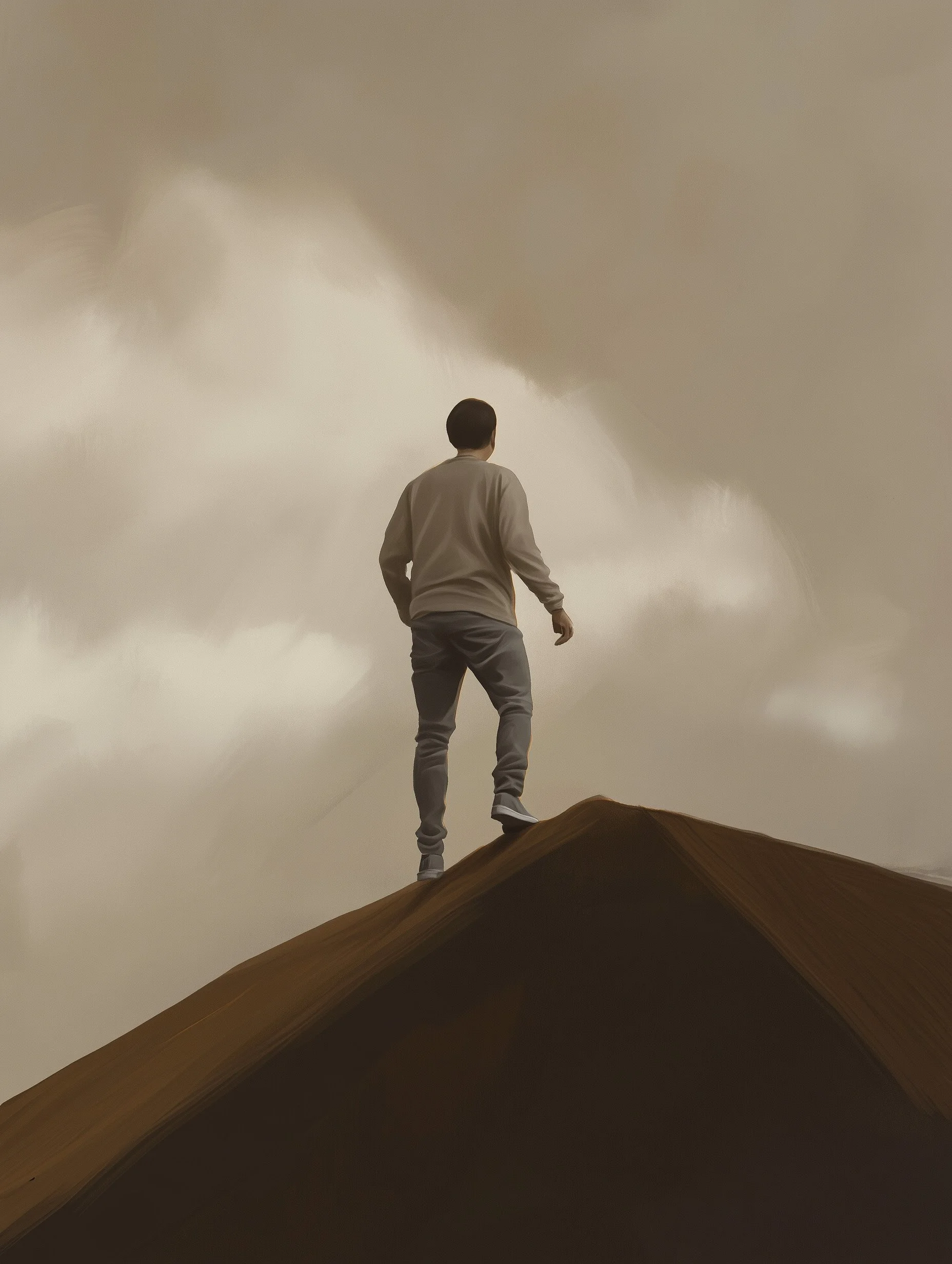
The dream analogy helps me stay at the frontier where physicalism and the mind-first hypothesis can still be held side by side.
When the word becomes part of the test
In this project, the dream analogy is not only a way of describing the inquiry. It is part of the inquiry. The word dream arrives with one meaning already in place — night dream, symbol, psyche, interpretation — and then gets asked to carry another possibility: that what we call reality may itself be more like appearance in consciousness than a fully external given.
That shift in meaning is deliberate. If the word can be felt differently, even for a moment, then perception may already be starting to move. In that sense, the language is not only explanatory. It is experimental.
Dream as symbol
To me, the dream symbol is the most meaningful and workable way into the inquiry I’m making. Psychologically, it helps me distinguish between the contents of experience — roles, conflicts, emotions, narratives — and the awareness in which those things appear. Philosophically, it gives me a way to test a possibility that has stayed with me for a long time: that consciousness may be more fundamental than the world we usually take to be solid and outside us.
That is really why “The Dreamer” matters to me. It does not point to the ego or the autobiographical self, but to something prior to that — the observing dimension of mind, and the condition in which all of this is happening. It gives me a language for asking whether some of our suffering comes from treating appearances, divisions, and inherited narratives as final, rather than as conditioned experiences within consciousness.
That is also why the phrase became We The Dreamer, rather than “we the dreamers.” The point was not to name a group, an identity class, or a community of separate people who happen to think alike. It was to test a stranger possibility: that what looks like many lives might be held within one field of awareness, and that the shared identity underneath our differences may be more primary than the differences themselves.
Dream as instrument
“I know I am borrowing a loaded, meaningful word, and I want to do so carefully.”
I also like the analogy because it does two things at once. First, it softens the default assumption that reality is simply a fixed external given to which the self must react. Second, it opens a shared frame: if experience is more dreamlike than solid, then identity may be less separate than it seems.
On a personal level, that makes We The Dreamer useful to me not as a belief system, but as a way of testing what happens if we go mind-first. What if consciousness comes before the world? What if the same awareness holds our experience together? What if one mind were appearing through every body, including mine?
If I layer those ideas into the day, does anything actually change? Does it loosen rigidity, reduce blame, and help me meet life with a little less defensiveness and a little more perspective — or not?
A careful borrowing
I know I am borrowing a loaded, meaningful word, and I want to do so carefully.
Because I know how deep and charged the word “dream” is — especially in psychology, and certainly in relation to Jung — I don’t use it lightly. I’m aware that I’m borrowing a word with a long symbolic life, and I want to do that with respect: for the traditions around it, for people whose work has been shaped by it, and for anyone who experiences the word as carrying real psychic and spiritual weight.
So for me, The Dreamer Project isn’t an escape from reality, nor is it — though I know the name can make this confusing — a project focused on our night dreams. It is a way of investigating whether awareness is more fundamental than the roles and conflicts that usually take over.
What the experiment is actually testing
If consciousness really is primary — if it comes before matter and spacetime, as Donald Hoffman argues and as Annaka Harris has seriously explored as a possibility — then what we call reality may be something appearing within it, rather than something fully separate from it.
I still reach for the analogy of a dream because that word carries hope for me. It leaves room for the possibility of waking, as mystics and contemplative traditions have long suggested, or at least of discovering that what we are is less damaged and less divided than it seems.
It is also a bold move. And I have to run the experiment in a way that respects what the word itself means to so many people.
For a more organized walkthrough of the symbol itself, see The Dream Analogy page.
Read The Dream Analogy →FROM THE ARCHIVES
Long before my current effort, the same tension was already there: the outer world pressing in, and the inner sense that experience always has more to give than it first appears to hold — as if what we call reality were always one degree closer to dream than we think.

Double-exposure photograph — 1999. Nikon FM2.